23I90
architects
ASP Faluz Mustain
Apartment at Jolshiri Abashon, Sec-11


BASIC INFORMATION
Aspiration Faluz Ltd.
Simplex multi-apartment
design year
2026
Multistoried Apartment
under construction
site area
5 katha
construction area
2340 sqm
Khandoker Tariqul Islam, iqbal hossen sunny
Plot:16, Road:510A, Sector:11, JOLSHIRI ABASHON, Bangladesh.
ASP Faluz Mustain
Simplex Multi-Apartment · Jolshiri Abashon, Sector 11, Dhaka · 2026
The plot on Road 510A, Sector 11 of Jolshiri Abashon faces south, an orientation that in the Dhaka climate brings the full force of the afternoon sun directly onto the building's primary facade. For a residential building, this demands a response that is both environmental and spatial, and 23/90 Architects have answered it with a facade that does not simply shield the interior but gives the shielded zone a purpose of its own.
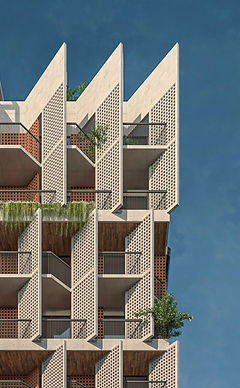
The perforated fair-faced concrete panels that run vertically through the building's facade are not a generic screening device. They are positioned specifically in front of reading rooms, spaces that require controlled, diffuse light rather than direct exposure, and benefit from the particular quality of filtered daylight that the punctured surface provides throughout the day. The perforations intercept the direct southern sun before it reaches the glass, casting soft, shifting patterns of light and shadow across the reading room interiors in a way that no opaque wall or conventional louvre could replicate. At night the effect reverses: light from within filters outward through the perforations, giving the building a quietly luminous presence from the street, each small square of light marking an inhabited room behind it.
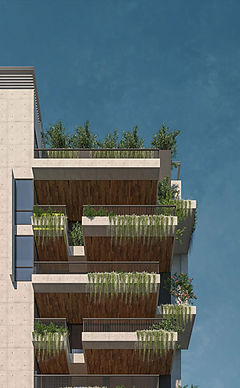
Between the perforated panels, the building's alternate floors open outward into triangular sky gardens, their angular geometry visible clearly in both renders as projecting diamond-shaped volumes that break the rectilinear discipline of the floor plates. These are not standard balconies. Their triangular plan creates a geometry of outdoor space that reaches in two directions simultaneously, expanding the resident's visual connection to the sky and street beyond what a rectangular balcony would allow. Planted at every level, with vegetation trailing from their edges, they read from the street as green triangular punctuations within the facade rhythm, alternating with the solid perforated panels above and below.
The warm timber-toned cladding on the balcony soffits and sky garden surfaces introduces material warmth against the building's restrained concrete palette, preventing the facade from reading as purely technical. At ground level, a glazed double-height lobby opens transparently toward the street, its planted surrounds easing the transition between the public realm and the residential floors above. At 2,340 square metres across a 5-katha site, ASP Faluz Mustain is a building that takes the difficulty of its southern orientation and turns it, room by room, into a considered spatial asset.