23I90
architects


Xeon Technology Limited
Corporate Office · Mirpur, Dhaka · 2023
The design begins with a provocation: how does a technology company assert identity within a constrained budget and an imperfect floor plate? At Xeon Technology Limited, 23/90 Architects answered not through concealment but through character, transforming spatial limitation into a deliberate design instrument.
The palette is built on deep petroleum blue, a chromatic choice that does considerable spatial work. Dark surfaces absorb the irregularities of the existing walls, dissolve the room's boundaries, and paradoxically expand the perceived volume. Against this field, acid yellow-green punctuates with precision, appearing as upholstered seating, shelf niches, and graphic accent planes. The contrast is not decorative but structural to the interior's legibility, creating a visual hierarchy that guides movement without partition walls.
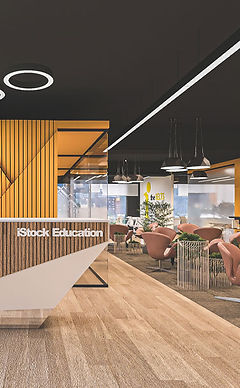
The entry screen is the project's most architecturally charged moment. An oversized X-form, rendered in white-trimmed volumetric panels with integrated LED reveals, operates simultaneously as brand signifier and spatial threshold. Seen through the glazed facade, it compresses and frames the interior beyond, turning the reception zone into a stage rather than a corridor.
Throughout the workspace, material economy is handled with intelligence. Oak-toned timber veneer runs across shelving, column cladding, and workstation surfaces, bringing warmth that counterbalances the cool depth of the surrounding walls. Warm-toned box shelves punctuate the dark field like a grid of illuminated niches. Linear pendant lighting, suspended in parallel runs, structures the open workroom and pulls the eye toward the window wall, where the city enters as light.
Motivational typography is embedded directly into the architecture, printed large across wall planes. This is not afterthought branding; in a space built for a young technology team, the words become part of the spatial atmosphere, reinforcing the culture the office is meant to house.
The project demonstrates that budget constraint, handled with conceptual clarity, produces spaces with greater conviction than many of far greater means.